





Article: How to Choose a Sofa: Four Sofa Families and the Way You Live
How to Choose a Sofa: Four Sofa Families and the Way You Live
A sofa is the piece you live with most. It holds family evenings, guests who stay too late, naps, arguments and reconciliations, often for ten years or more. So when clients ask us where to start, we never begin with fabric or colour. We ask: how do you actually live in this room?
The short answer: Choose a sofa by the way you live, then by its shape: a curved sofa for conversation, a sculptural sofa that can float for a gallery-like room, a modular sofa for homes that keep changing, and a low, deep sofa for lounging. Fabric and colour come last.
The new Maison Burgos collection is organised the same way, into families of shape. Here is how to tell them apart, and how to know which one is yours.
Tateyama: for conversation

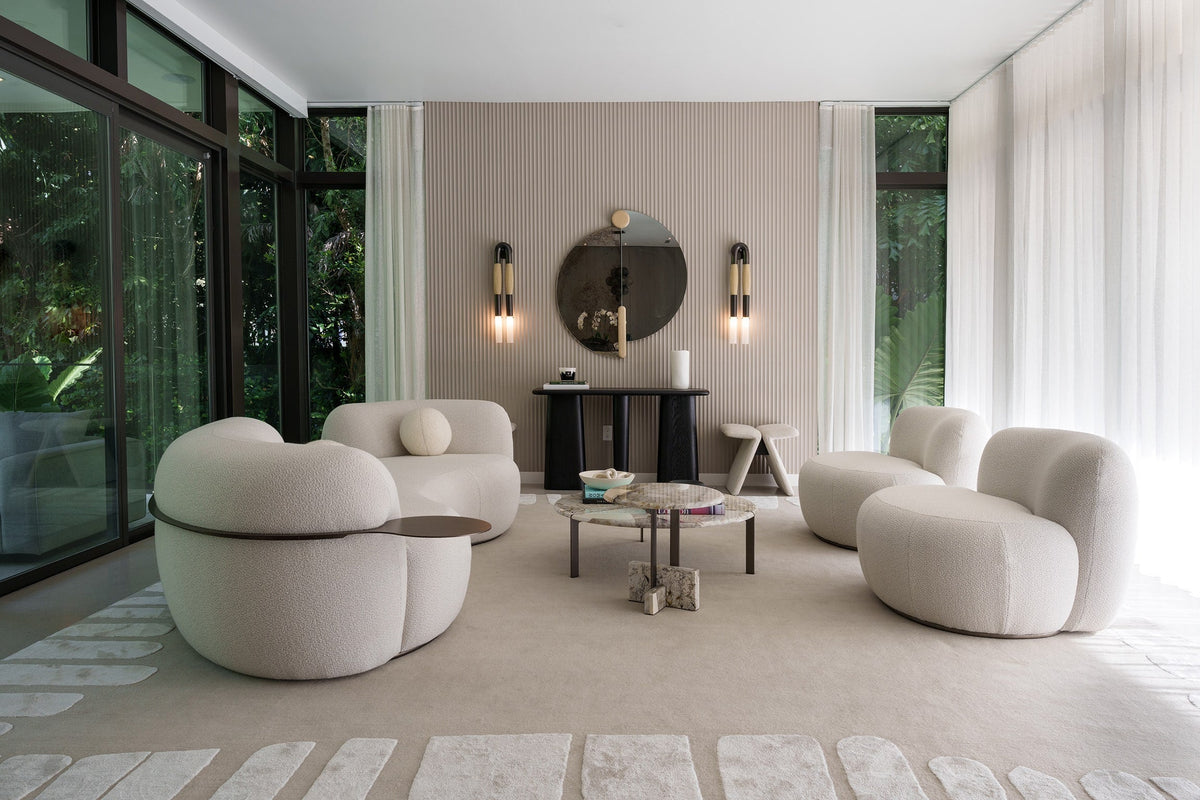
The Tateyama Curved Sofa is what we call a conversational sofa. Its curve turns the people seated on it toward one another, the way chairs naturally drift into a circle at the end of a good dinner. A gap is carved into the backrest so the sofa never closes itself off from the room, and side tables are built right into the form on a continuous steel band finished in satin or polished metal, or in a lacquered colour.
Choose Tateyama if your living room is built around talking rather than television. It wants to float, ideally facing a fireplace, a window or another seat.

The family grows with your space. The Tateyama XL Sofa stretches the same idea to 118 inches with low, individual backs, and the Tateyama Cloud Sofa softens every edge into something closer to a cloud.


Carmel: for sculpture
Some sofas are furniture. Carmel is closer to sculpture. The Carmel Sofa has generous, rounded volumes and a low profile that look as considered from behind as from the front, which is exactly the point: Carmel is designed to stand in the middle of a room, not hug a wall.

The Carmel Marble Modular Sofa goes one step further, setting the modules on solid blocks of natural marble. The upholstery seems to hover, and because the stone is natural, the veining and tone change from block to block. Choose Carmel when the sofa is the art.

Mosaico: for rooms that change
Life rarely stays in one layout. A new apartment, a new baby, a party for forty, a teenager who suddenly needs the den. The Mosaico Sectional Sofa – Composition 2 is built for that. Its upholstered modules lock together like tiles, each marked by the signature arched cut-out that gives the family its name, and they can be rearranged or added to as your life moves.

Choose Mosaico if you rearrange furniture as often as you change the seasons.
Slide and Moritz: for soft, low living
And then there are the sofas you sink into. The Slide Sofa is built from soft, stacked volumes that seem to glide past one another: a rounded back resting on a deep seat, floating on a recessed base. It is fully upholstered on every side, so it looks finished from any angle.

The Moritz Sectional draws one long, gentle curve with a sweeping chaise and a 16-inch seat. Low seats change how a room feels: sightlines open up, ceilings feel higher, and everyone instinctively relaxes. Moritz is the one family in this story that is in stock, in Licorice or Alabaster bouclé. (We designed a whole evening room around the Licorice version in After Dark.)

The supporting cast: what goes around the sofa
A sofa is only half a room. What sits in front of it and beside it decides how the room is used. A low, generous coffee table invites people to lean in; a pair of tables at two heights makes room for a drink and a book; an armchair facing the sofa turns a seating area into a conversation; an ottoman is the most flexible seat in the house.
A few pairings we return to: the Fragment Coffee Tables, a set of three in red marble at different heights, grouped beside a pale modular sofa or pulled apart for a party; the Pangea Coffee Table, two monolithic halves in stained ash, each on a single leg, for a deep lounging sofa; the Bonnie & Clyde Coffee Table, carved from a single block of Nero Marquina, with a curved bouclé chair; and the Panorama Armchair in green velvet as the colour in a cream room.


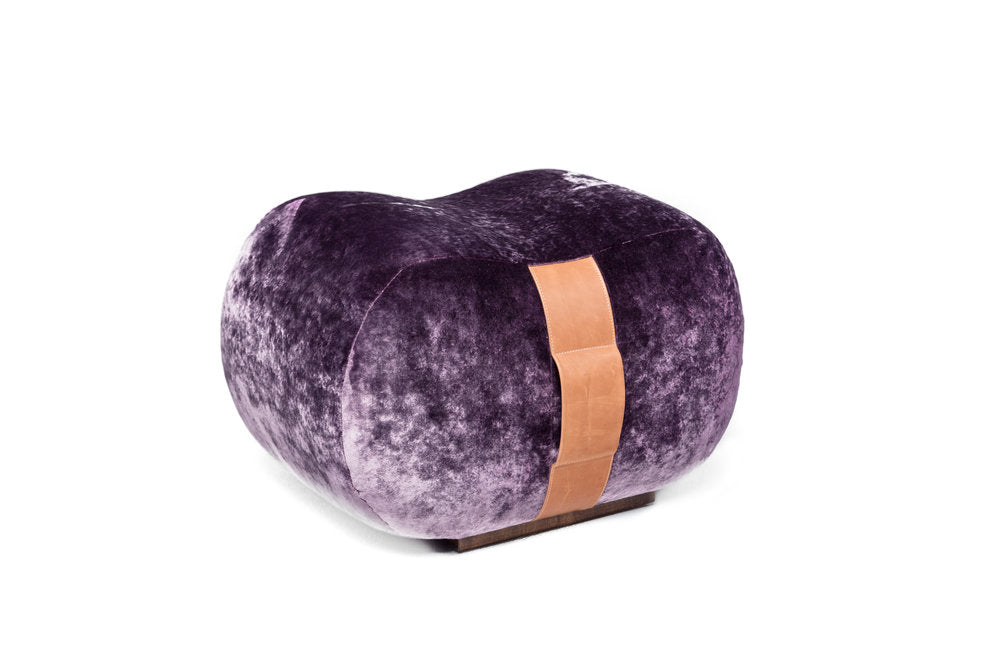
And always one ottoman. The Malibu Ottoman in terracotta velvet is a footrest on Sunday, a seat when the room fills, and a tray table with the right tray.

Which sofa family is yours?
- You host and talk: Tateyama, Tateyama XL or Tateyama Cloud.
- Your room is a gallery: Carmel or Carmel Marble Modular.
- Your life keeps changing: Mosaico.
- You lounge, read and nap: Slide or Moritz.
A designer's rule of thumb
Leave about 18 inches between the sofa and the coffee table, and 30 inches for walkways. In Feng Shui, place the sofa in the command position: its back to a solid wall, facing the entrance, so you can see who comes in. If your sofa floats, as curved and sculptural sofas often should, a console behind it gives the same sense of support.
Frequently asked questions
How do I choose the right sofa shape for my living room?
Start with how you use the room, not with fabric. If the room is for conversation, choose a curved sofa that turns people toward one another. If it should feel like a gallery, choose a sculptural sofa that can float. If your life changes often, choose modular. If you lounge more than you sit, choose a low, deep seat.
Are curved sofas practical?
Yes, when the room allows them to float. Curved sofas need about 18 inches of clearance in front and 30 inches for walkways, and they work best with a round coffee table. They are excellent for conversation and for breaking up a boxy room.
What is the difference between a modular and a sectional sofa?
A sectional is a fixed configuration, usually with a corner or chaise. A modular sofa is made of independent pieces that can be rearranged or added to over time, like the Mosaico and Carmel modular sofas.
How far should a sofa be from the coffee table?
About 18 inches, close enough to reach a cup and far enough to walk past your knees. Leave around 30 inches for main walkways.
Where should a sofa go according to Feng Shui?
In the command position: back against a solid wall, facing the room's entrance, without being directly in line with the door. If the sofa must float, a console behind it gives the same sense of support.
How long does a made-to-order sofa take?
Most Maison Burgos sofas are made to order in your choice of fabric and ship in 10 to 16 weeks depending on the model. The Moritz Sectional is in stock and ships in two to four weeks.
Read more on why curved furniture is here to stay.
Every sofa in this story is made to order in your choice of fabric. Explore our sofas and sectionals, or write to info@maisonburgos.com to request swatches. Designers can request project quotes through our Trade Program.
Written by Marie Burgos, founder of Maison Burgos and of Marie Burgos Design, the New York interior design studio she established in 2007. Marie is an NYU-trained interior designer and Feng Shui Master. She founded Maison Burgos in 2018: a collection of furniture, lighting and objects curated by Marie, including pieces of her own design, brought to life with the craftsmen and artisans she works with.

Written by Marie Burgos